Solution
Turn Utility Bills into Decision & Audit-Ready Data
Turn utility bills into trusted data. Parsepoint extracts and semantically processes invoices to deliver structured energy, cost, and utility data, complete with anomaly detection, dashboards, reporting, integrations, and source-linked audit trails.
Trusted by Dozens of National and Multinational Organizations.




When Every Meter Counts, Manual Data Entry Doesn't Scale
The more locations, meters, and utility accounts you manage, the harder it becomes to maintain accurate reporting and control costs. Hidden billing errors, rate changes, and usage trends often go unnoticed. We transform scattered utility bills into structured, traceable, decision- and audit-ready data.
Who it's for
Multi-location organizations
Consolidate electricity, gas, water, and waste bills from dozens of sites into a single Scope 1 & 2 inventory—no chasing invoices facility by facility.
Energy & sustainability consultants
Onboard client portfolios in hours, not weeks. Surface reduction opportunities and deliver defensible, audit-ready reports across every account you advise.
Real estate asset managers
Track thousands of meters and sub-meters across tenants, common areas, grounds, and irrigation with accurate attribution and portfolio-wide intensity.
Every utility covered
Electricity
kWh · MWh · Peak Demand · Onsite Generation
Natural Gas
MCF · SCF · Therms · MMBtu · CCF
Water & Sewer
Gallons · CCF · Cubic Meter (m³)
Waste & Recycling
Tons · Metric Tons
Visualize consumption, costs, and emissions across your entire portfolio with facility-level granularity and automatic unit normalization.
See the platform in action
From intelligent OCR extraction to automated reporting dashboards, explore the workflows that power enterprise utility data management.
Verification workflows & audit trails
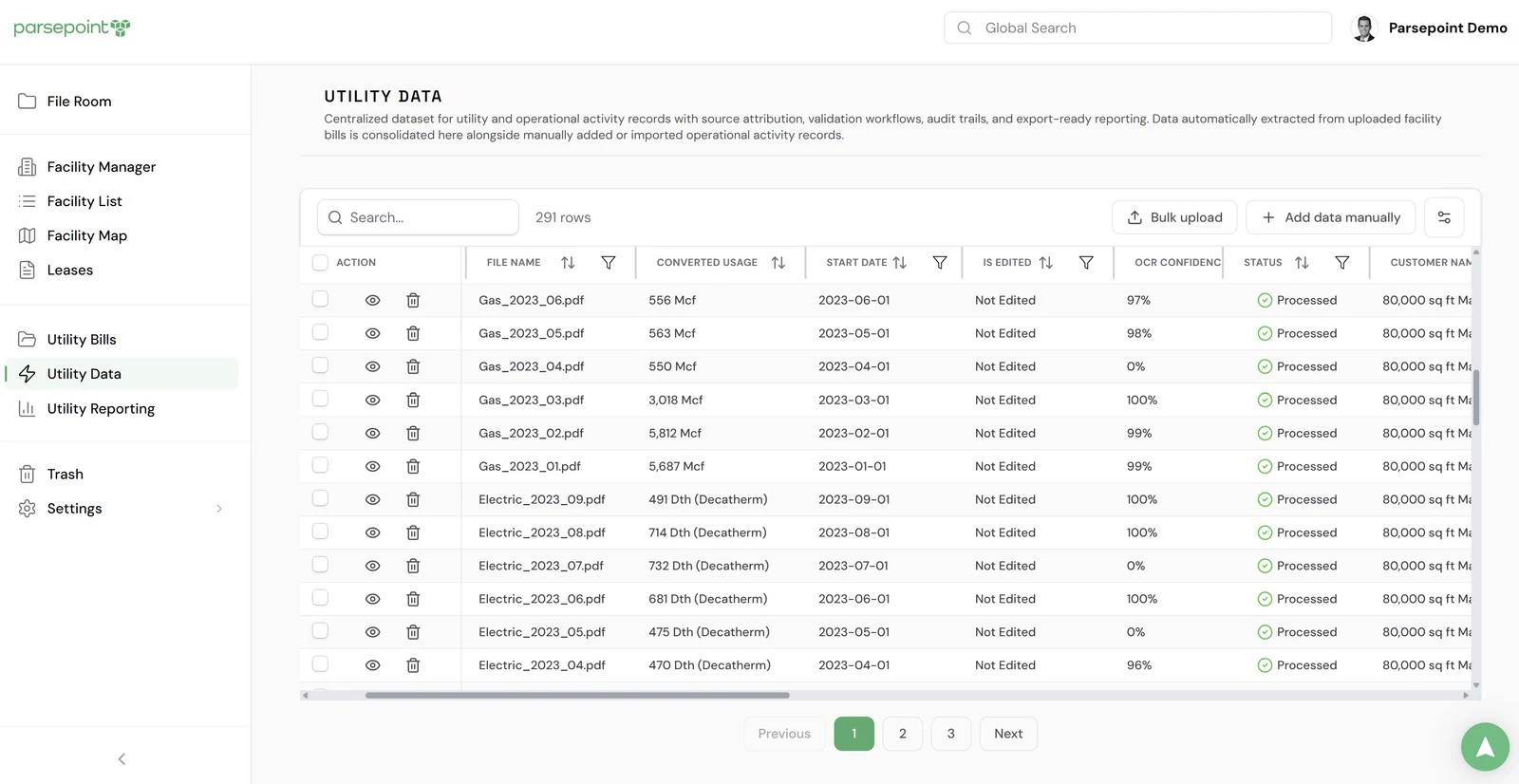
Track every document through processing with confidence scores, verification status, and complete edit history. Filter by verified/unverified status and drill down into individual records for full audit transparency.
Visual field identification & drilldowns
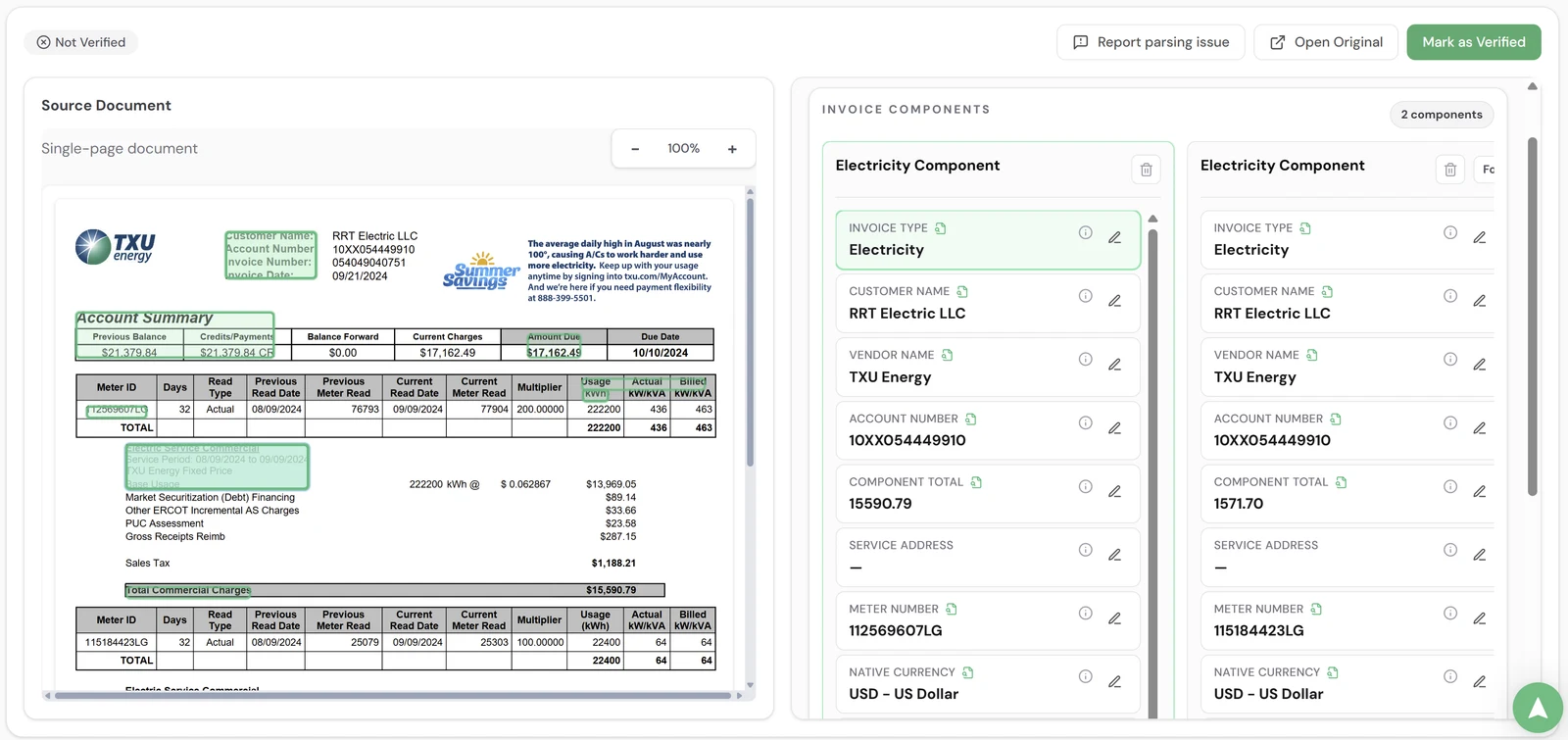
Side-by-side document viewing with highlighted extraction zones. Click any parsed field to see exactly where it was captured from the source document. Edit, verify, and save changes with full version control.
Automatic unit of measure conversion
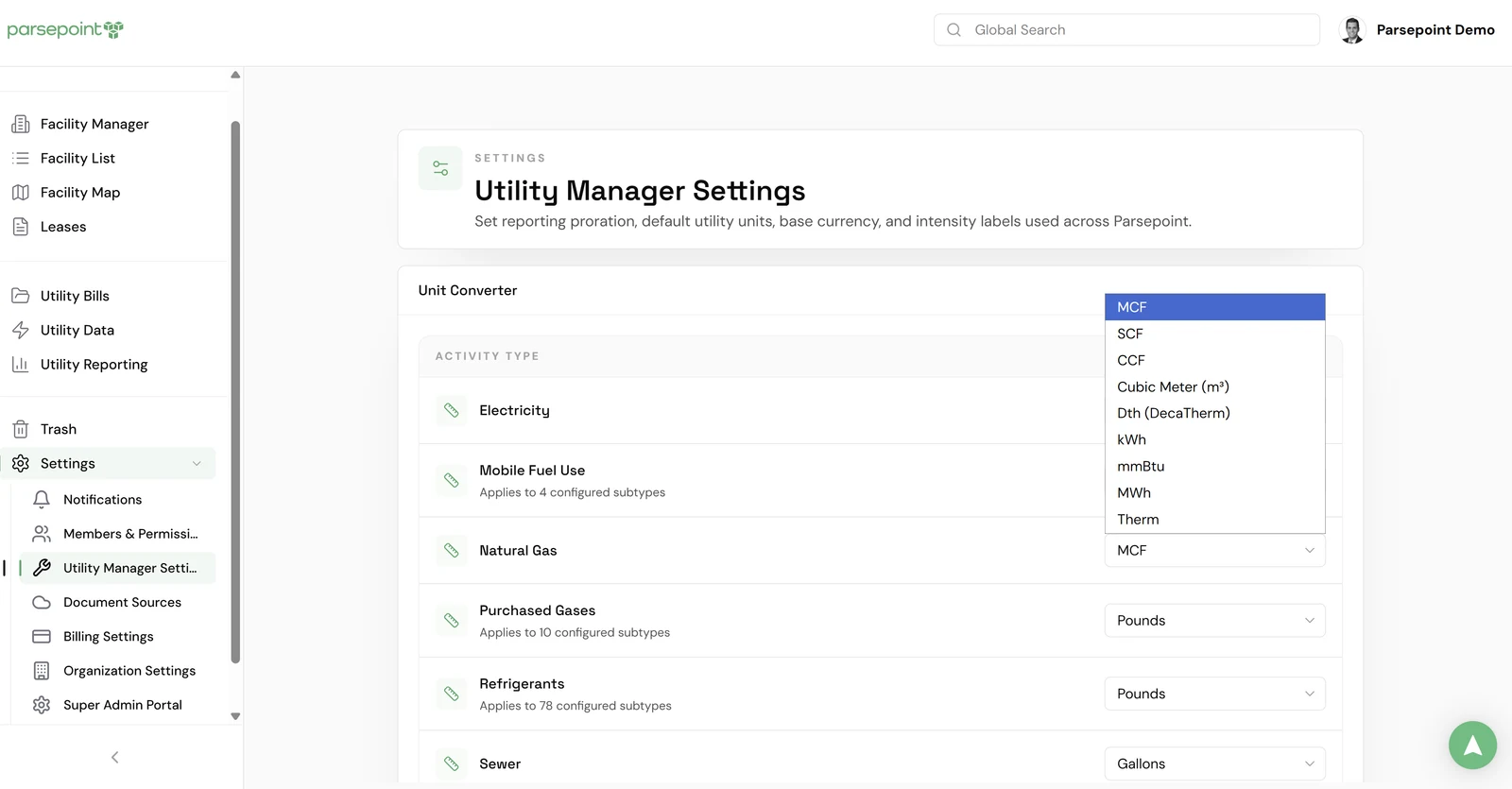
Configure standard units for each utility type and let Parsepoint handle the conversions automatically. Supported energy and volume units include kWh, mmBtu, therms, ccf, scf, MCF, joules, megajoules, and gallons—plus multi-currency normalization for global operating centers.
Interactive dashboards & automated alerts
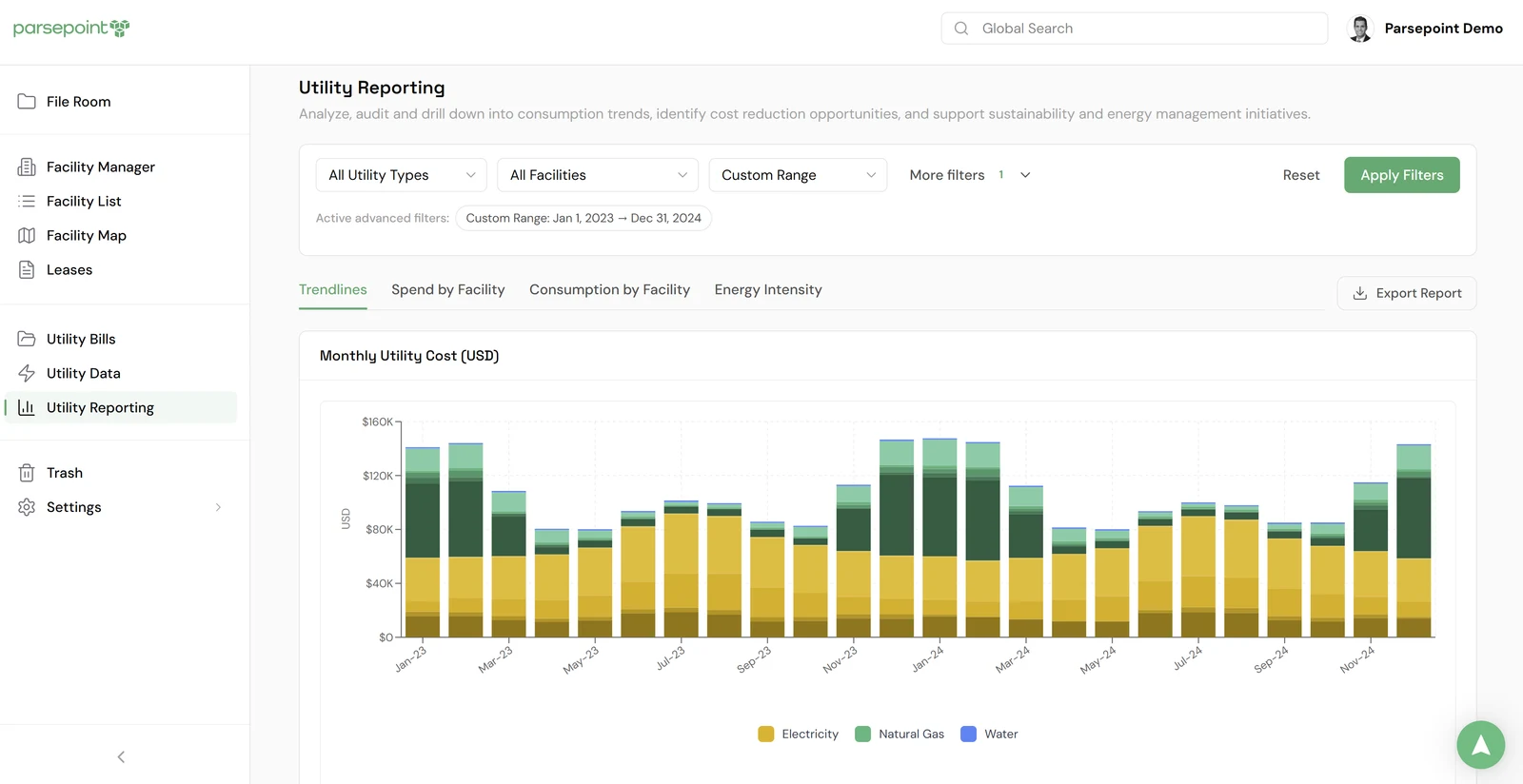
Visualize consumption and cost trends with filterable dashboards. Segment by utility type, facility, or time period. Export reports, track energy intensity metrics, and configure automated alerts for budget thresholds or usage anomalies.
See it on your own documents
Get in touch and we'll show you Parsepoint parsing your utility bills end to end—accuracy you can audit, dropped straight into your reporting workflow.
Custom schemas built for your bills
Parsepoint goes beyond OCR with true semantic understanding. We build custom extraction schemas on your bills — leveraging 1,000s of existing schemas and working directly with your team to reach 99%+ accuracy on the exact fields you report on.
Explore the Custom Schema Builder1,000s
Prebuilt schemas
99%+
Extraction accuracy
Any
Bill or invoice layout
100%
Source-linked fields
One platform, end to end
Everything You Need to Turn Bills into Insight
From automated collection to audit-ready reporting, explore the capabilities that power reliable utility, energy, and emissions data. Select any feature to learn more.
Connect your online utility accounts once, and Parsepoint automatically retrieves new bills, interval data, and account information as they become available. Eliminate manual downloads, email forwarding, and missing invoices while ensuring your utility data remains current, complete, and always ready for reporting, budgeting, and audit.
Automatically standardize utility data across electricity, natural gas, water, wastewater, district energy, fuel oils, and more into consistent units of measure. Parsepoint eliminates manual conversions, making it easy to compare facilities, aggregate portfolios, and produce reliable sustainability and financial reporting.
Every dashboard, chart, and reported metric is fully traceable back to its source. Drill from portfolio-level analytics to individual facilities, accounts, meters, invoices, and even the original utility bill in just a few clicks—providing complete transparency and confidence in every reported number.
Transform thousands of utility bills into actionable insights with powerful dashboards built for finance, sustainability, operations, and facilities teams. Analyze consumption, energy costs, emissions, utility rates, trends, and portfolio performance across any combination of facilities, utilities, accounts, meters, or reporting periods.
Detect unusual consumption patterns, unexpected cost increases, missing bills, duplicate invoices, abnormal meter readings, and data quality issues before they become reporting problems. Automated alerts help your team investigate issues faster and reduce costly billing errors.
Every utility bill, extracted data point, manual adjustment, and system activity is securely tracked with a permanent audit history. Instantly access supporting documentation, understand exactly how every reported value was generated, and dramatically reduce the time required for internal reviews, external audits, and assurance engagements.
Build more accurate utility budgets using historical consumption, weather patterns, seasonality, and cost trends. Continuously compare actual performance against budget, identify forecast variances early, and update projections automatically as new utility data becomes available.
Know exactly where data is missing before it impacts reporting. Parsepoint provides a comprehensive completeness view showing expected versus received consumption data across every facility, account, meter, utility type, and reporting period. One-click actions help identify gaps, request missing bills, and navigate directly to supporting source documents.
Seamlessly export standardized utility data into leading ESG and carbon accounting platforms, including Workiva, ENERGY STAR Portfolio Manager, Watershed, Persefoni, Gravity, Sinai, Normative, Greenly, Unravel Carbon, and many others. Deliver structured, audit-ready utility data without manual formatting or spreadsheet manipulation.
Benchmark facilities using trusted, auditable utility data to identify top and bottom performers across your portfolio. Compare energy intensity, utility costs, emissions, tariffs, and operational efficiency to prioritize energy projects, capital investments, and sustainability initiatives with measurable financial impact.
Identify opportunities to reduce utility costs by analyzing tariffs, demand charges, rate schedules, and utility pricing across your portfolio. Compare facilities against available rate plans, monitor changes over time, and uncover savings opportunities that often go unnoticed in day-to-day utility management.
Why Parsepoint vs Traditional Energy & Sustainability Tools
Built for Automation. Not Data Entry.
Traditional approaches rely on manual PDF extraction, offshore processing, and static spreadsheets. Parsepoint delivers AI-native utility parsing with audit-ready traceability from day one.
| Capability | Traditional Approach | Parsepoint (AI-Native) |
|---|---|---|
| Data Extraction | Manual PDF entry or offshore processing | AI utility bill parsing across all formats |
| Audit Traceability | No audit trail or source linkage | Every data point tied to source document |
| Cross-Facility Data | Inconsistent formats, no normalization | Standardized data across portfolios |
| GHG Workflow | Static spreadsheets, no automation | Built for Scope 1 & Scope 2 reporting |
| Data Updates | One-time uploads, delayed cycles | Continuous data pipeline with ongoing ingestion |
| Anomaly Detection | Errors discovered during review | Spot utility spikes to save money & reduce emissions |
90% of your Scope 1 & Scope 2 data in minutes
Electricity and natural gas usage across your entire portfolio—extracted, normalized, and audit-ready without manual data entry.
Start automating your document workflows today.
Try Parsepoint free and see how intelligent document parsing accelerates your team's workflows — no credit card required.